RPG Creations and Musings.

Archive for the ‘RPGs’ Category

What have I been doing?


Gosh, it’s been ages since I posted a new blog entry. I hadn’t meant to let it go so long. So if I haven’t been writing here, what have I been doing? Well, here’s a quick run-down, at least as far as it relates to RPGs.

Seven Hills

I teamed up with my faithful comrade in arms Graham Spearing to organise a new RPG convention, Seven Hills. It was my first time organising such a thing. Seven Hills 2014 was a fairly small affair with about 40 people attending. The atmosphere was wonderful, and thoroughly relaxed. It was focused with a science fiction theme. I played in three games (a Savage Worlds space opera, a game in the new River of Heaven setting, and a game of Eclipse Phase) and ran two (a game of Wordplay in my own Starfall setting, and a game in the Transhuman Space setting, but powered by Fate Core), and thoroughly enjoyed them all.

It was two months ago now, so it’s probably a bit too late for post convention analysis, but I’m looking forward to us organising 2015, which has the theme of Steel.

Playing Games

Besides games at Seven Hills, I’m playing and running other things now. I’ve recently fallen a bit in love with 13th Age, which I’ve decided is <i>my</i> D&D. I’m using it to run a game of an old love, which I thought I’d never return to, namely the Planescape setting. I might post more about the campaign later on, but for now I’ll say that it’s wonderfully straightforward to run, with enough tools to keep it interesting.

I’ve just started playing in a game of Esoterrorists. It’s smooth and subtle so far (we’re only one session in), with notes of creepiness just starting to build. I do like the Esoterrorists premise, and do like the Gumshoe system. I’m keen to find out what happens next.

Finally I’m involved with a fun play by post game, namely De Profundis. By play by post, I mean it literally- we’re sending hand written letters to each-other. The game is set in 1893, and plays with notes of Lovecraftian horror. This is by it’s nature a slow mover, but now it’s getting really interesting.

Writing

I’ve been doing quite a bit of writing, just not on this blog. Let me give you a list.

  • My OpenQuest setting with Simon Bray, Crucible of the Dragons (formerly known as Here Be Dragons) came out earlier this year.
  • I’ve finished an expanded draft of my Starfall setting. It’s a 1950s alien invasion setting for Wordplay, intended to play more at the hardish SF rather than pulpy end of the scale.
  • I’ve finished significant revisions to Ninth Legion for Reign. This is starting to sing.
  • I’ve added a scenario to a revised version of Blood of the Gods, which is now out there in the wild.
  • I’ve literally just now finished the first draft of a scenario pack for Age of Arthur.

I’ve also written or am writing a couple of other things for publishers who haven’t announced them yet, so I won’t do it here. So there’s been lots keeping me busy.


Space Combat in Fate

Fate is one of those game systems that brings out my urge to tinker. Hence, despite the fact I can, off the top of my head, think of five different Fate-based RPGs involving spacecraft and space battles, I’ve come up with yet another system for battles and chases between spacecraft. It owes something to the system in Diaspora, but it’s simpler.

So rather than have this system languishing on my hard drive (though I intend to bring it out to play at the Seven Hills science fiction RPG convention), I thought I’d share. It’s raw, and lacks examples, and I may or may not polish it up into something more refined, but it’s been a while since a new blog entry.

Spacecraft Quantities

Spacecraft are described by one or two Aspects, and the following quantities, rated from 0 to +5:

Cargo

Elecronic Warfare

Sensors

Thrust

Weapon Systems


A spacecraft can have more than one Weapon System. This enables multiple attacks. Weapons Systems should be named things like “X-Ray Laser”, “Particle Beam”, “Antimatter Torpedoes”, “High Capacity Railgun”. This has no mechanical effect, but sounds more interesting.

Spacecraft also have stress tracks in:

Data

Heat

Hull

These stress tracks start off at 2 each. A Spacecraft can also have stunts which increase the length of one stress track by 1, give a spacecraft a shuttle or lander, or give a +2 bonus to a quantity when used for defensive purposes.

Building a Spacecraft is points-based. A Spacecraft has a level, from 1 to 5, representing how expensive and advanced it is. It is created using a number of build points equal to five times its level.

All quantities start at zero. Each point in a quantity costs one build point up to the spacecraft’s level. Raising a quantity above a spacecraft’s level is allowed, but each increase costs two build points.

Stunts cost one build point each.

If a spacecraft has a quantity at zero, it can’t use that quantity. For example, with Thrust 0, a spacecraft is a static space station.

Crew

A Spacecraft needs a crewmember as a Pilot, Communications officer (if involved in electronic warfare), and a Gunner for each weapon system. An engineer is also convenient. The skill of a crewmember modifies a spacecraft’s quantity.

  • If the crew member’s skill is higher than that quantity, add 1 to it.
  • If a a crew member’s skill is lower than that quantity, take 1 away from it.
Quantity Crew Skill
Thrust Pilot
Weapons System Ranged Combat
Sensors Computers
Electronic Warfare Computers


A spacecraft does not have any Fate Points of its own, but can use those of its crew on manoeuvres they perform.

Space Combat

Rounds in space combat vary in length, and could represent minutes or even hours of game time. Each round is divided into phases with different activities.

  • Manoeuvres.

Each pilot decides whether they are seeking to flee, perform evasive action, or attack manoeuvres. The pilot of the vessel with the lowest sensors quantity acts first here.

Evasive action or attack manoeuvres means making a skill test using the Thrust quantity at difficulty 1, as per the usual Fate rules. Success means you can Create an Advantage, which lasts the rest of the round, and can be used once at no Fate Point cost. Success with style means the Aspect placed lasts two rounds, and can be used twice at no Fate Point cost.

If instead, a spacecraft decides to flee, they need to make an opposed Thrust test with another vessel, with the level of success applied as stress to the losing vessel’s Heat stress track.

A vessel taken out through Heat stress can no longer act in the manoeuvre phase of combat, and can certainly no longer Create Advantages, pursue, or flee. Taking another vessel out by deciding to flee means you’ve got away.

  • Electronic Warfare

In this phase, the vessel with the highest sensors quantity acts first. If you want to engage in electronic warfare, pick another vessel and make an opposed Electronic Warfare test. The loser of the test takes stress to their Data stress track equal to the degree of success. This damage applies regardless of who initiated Electronic Warfare.

In a combat with multiple vessels, you can’t initiate Electronic Warfare if it’s already been used against you this round.

A vessel taken out through Data stress is disabled.

  • Weapons

In this phase, the vessel with the highest sensors quantity acts first. An attack is a Weapon System skill test, opposed by a Thrust skill test used for defence. The Advantages created in the Manoeuvres phase can be used here.

If the attack succeeds, it does damage to the Hull stress track equal to the degree of success. A vessel taken out through Hull stress is disabled permanently or even destroyed.

  • Engineering

An engineer can make a skill test (their own, rather than the spacecraft’s) to repair damage to one stress track. The difficulty is the amount of damage that track has taken. The degree of success is the number of points of stress repaired.

Spacecraft can take Consequences the same as characters, but these take longer to fix.

Science Fiction is Hard?

Since I’m organising a Science Fiction RPG convention, it’s high time I wrote something here about science fiction RPGs. On forums and such, I often come across the statement that science fiction roleplaying games are tougher to “get” than fantasy. I don’t think this is true for me, but I’m not going to argue with this statement- if someone says something’s tougher to do, then it genuinely is tougher to do, at least for them.

However, there certainly are a few features of science fiction gaming that don’t always come up in fantasy, both from a player and a GM viewpoint, and which need some thought.

The Technology

Okay, in fantasy, the erm fantastic element comes mainly from magic. In science fiction it usually comes from high technology. Okay- so far, so good, right? Now, the only players in an RPG who needs to know anything about magic are those playing characters who use magic- and even then, they only really need to know what magic their own character knows (sure, a GM might give a quick explanation of something else encountered with a relevant skill check or something, but that doesn’t change this point). The thing is that magic is the exception rather than the rule.

Now when it comes to technology, some of it’s going to be omnipresent. What sort of communications are out there? Travel? Access to information? Medical nanotechnology? Are things like quickfire universal 3d printers easily available? There are things the players need to know, as well as the player characters, unless play begins in an isolated or backwards location.

It’s only technology that’s above the norm, and isn’t available to everybody, but only available to some characters, that really works like RPG magic.

Big Ideas

For me, the big inspiration for RPGs is books rather than films or TV series. I don’t see RPGs as a very visual medium. This is not to say I don’t picture things when playing or running a game, or even preparing it- the same way I picture things when reading. This is maybe a topic worth returning to in a future post, but for now I’ll leave it.

Now, most fantasy novels map reasonably well to RPGs. The classic quest to defeat the dark lord through a hidden weakness, or sneaking into a heavily guarded and trapped wizard’s tower to steal a ruby the size of an egg- both feature heavily in RPGs. So does fantasy worldbuilding, backstabbing political intrigue, and all sorts of other features from good and bad fantasy novels.

When it comes to Science Fiction, many stories (especially “hard” SF stories) don’t have a plot based around a quest, politics, or anything familiar from fantasy. They involve a BIG IDEA, and it’s logical consequences, along with a dollop of good old-fashioned sense of wonder from them. The BIG IDEA might be genetic engineering, an explanation of the Fermi paradox, the science of psychohistory, the laws of robotics, time travel paradoxes, relatavistic time dilation, or the heat death of the universe.

The BIG IDEA isn’t just background in such stories- it’s what the whole thing is about. The BIG IDEA is often an extrapolation from genuine science. I’m not saying fantasy doesn’t feature big ideas, and exploration, and a sense of wonder, and logical consequences- of course it can and does, certainly at its best.

But this notion of a BIG IDEA is harder to capture in roleplaying, and not something that’s present in most Science Fiction RPGs. In an RPG, it may well be better in the background than the foreground. It means most Science Fiction in roleplaying isn’t going to feel much like a big chunk of science fiction literature.  This is not necessarily a bad thing, but I think it’s worth looking out for- and a big difference to fantasy.

2014 Game Plans

Now it’s time for part two of my end of year reflections, but rather than looking back over 2013, I want to look forward to 2014 and talk about my plans. I won’t call them resolutions, for then they’re certain to get broken.

First of all, several times on forums, I’ve mumbled something along the lines of “that’s why I’ll never organise a convention”. I was lying, and always knew it deep down. That’s why I’m no co-organising an RPG convention in Sheffield, UK, on the 26th and 27th of April, called Seven Hills. To make it stand out a bit from general RPG conventions, there’s a strong science fiction theme with most (or going by the submissions so far, even all) of the games being science fiction based. There’s still room for more people to register (yes, please) and more games, but I think things are going well. I don’t want to say more unless my optimism mysteriously curses it. If you’re interested, there are more details available from following the above link. You can register here.

Undoubtedly, I’ll be saying more about Seven Hills in future blog entries. It’s something new for me, and I’m excited!

Then there’s writing. I’ve several projects on the go, as I may have mentioned in previous posts, and I’ll undoubtedly be talking about some of them at greater length in future posts. I’m not going to prioritise my babies, so instead, I’ll list them in alphabetical order.

Age of Arthur campaign pack

I want to bring out some support for Age of Arthur. The sales are good, and I have lots of notes from campaigns I’ve run. It’s mainly a case of organising them, I hope. And I’ll have the help of Graham Spearing, and his ideas, in bringing this to fruition. Watch this space- there will be more details when I have them.

Empire of Ys

This is a fantasy game involving an empire with cities on several planes of existence, and its corrupt capital city. If you sense something of a love letter to the old Planescape setting as one influence, you wouldn’t be reaching too far. I wouldn’t quite call it an Old School Rennaisance game, but the rules are based partially on older versions of D&D, and some more “modern” mechanics for things like character motivations and experience. I can’t leave this alone, and I’m over half way through a first draft. My plan for 2014 is to get that first draft finished, and then start playtesting.

New Frontiers

Another complete game, this time based around the One Roll Engine. It’s space-based fairly hard science fiction, set about a thousand years in the future. Things have regressed to something of a dark ages due to a big interstellar war between humanity and an alien species, followed by a reluctant peace. I’m about a quarter of the way there with this, with most of the base assumptions worked out. I hope to have a first draft by the end of the year, and then, again, move to playtesting.

Ninth Legion

This is written and with the editors, and I’ve had fun running it in 2013. It’s a setting where the Ninth Legion of the Roman Empire was transported to a Celtic Otherworld, and carved out a new empire there. I hope to see this released into the wild next year, after making changes and clarifications suggested by editing and external playtesting.

Paris 1968

A short Gumshoe-based city write-up in the city and time mentioned. Not much actual writing yet, but some ideas, some discussion, and some required reading. I aim to get this done quite early in the year.

Starfall

This is going to be a short (30 to 40 pages) setting and scenario pack for Wordplay. It’s based around an alien invasion of the Earth in 1952. I have a first draft, but it needs expanding a little bit, not to mention playtesting. I aim to run a session of this at Seven Hills too.


Okay, that’s a lot of writing, but one of the above is pretty short, and two are all but done. I think I can manage it. Last, but not by any means least, how about playing? Well, here’s what I’d like to run and play in 2014.

Running

  • Finishing off the 1968 Night’s Black Agents campaign I’m running. Yes, this is linked to the Paris 1968 project.
  •  Run games of Empire of Ys, New Frontiers, Ninth Legion and Starfall.
  •  Run some games at Seven Hills.  I’m planning an outing for Starfall, and some science fiction in the Transhuman Space setting, powered by Fate Core rather than GURPS.
  • Run a Wild Talents one-shot game, possibly involving the Progenitor setting, where people suddenly get superpowers at a 1970s rock concert.  This is likely to be a convention game.
  • Doing something Viking-based with Runequest 6 really quite excites me.
  • Running a one-shot of Godlike also excites me.
  • I quite fancy running a short campaign of Clockwork and Chivalry.  Historic stuff excites me- can you tell?
  • I’ve fallen a little bit in love with Trail of Cthulhu, and would like to run a single extended story over about four or so sessions.
  • I want to run a game over Google+ hangouts. I’ve had some good experiences playing such, so it’s time to give something back. This is of course entirely consistent with the above games.

Playing

  • I’d like to play one of the games based on the Apocalypse World Engine. There’s quite a few out there- Apocalypse World itself, Dungeon World, Monster of the Week, Monsterhearts, Sagas of the Icelanders and Tremulus spring to mind. I most like the look of Monster of the Week and Sagas of the Icelanders, though Dungeonworld also calls to me a touch. There’s a lot of buzz about the system, and I don’t fully “get” it based just on a read through.
  • Another one I’d like to play and haven’t got round to is The One Ring. I’ve heard good things about the game and bad things about its organisation.
  • I want to play some space opera, and play some gritty hard science fiction. Maybe Seven Hills will deliver it to me.
  • Play some 13th Age. This game is getting me excited about D&D-style settings all over again.

That will do for now. Some of the plans are likely to go out the window, but better to shoot high! At any rate I’m going to be lucky to get through that lot!

My Year in Gaming

It’s the end of the year, and so I’m naturally drawn to review what went on in it, and think about what I want from the next. In this entry, I want to talk about what went on, at least when it comes to RPGs.

Firstly, games I’ve played. There was a one-shot of Legend of the Five Rings, a fantasy game based on east Asian tropes. I rather enjoyed it, and would have liked to play more, as there were lots of seeds for that, but such is life.

Then there was Esoterrorists over Google+ hangouts. This was an eye opener in two ways- both letting me discover how the Gumshoe system works (I’m now a zealous convert), and the joys of gaming over hangouts. Hangouts gaming was a jar to the system; for the first hour ago, I found myself simply thinking “this is odd”, and not really relaxing into it, but then something clicked, and I came to see it as being about 75% as good as face to face gaming, at least when there are no technical problems with sound and so on. The experience led to me trying some Traveller online, and rediscovering the joyful game of Traveller character generation and the richness of world building in the Traveller universe.

Finally there’s convention games. At ConQuest, I got to play rather than run Fate for a change, in the form of a wild west horror game. At Furnace, I got to play Dogs in the Vineyard and MouseGuard. I loved them all.

In 2013, I ran more games than I played. I ran a few sessions of the Dresden Files RPG set not in modern times, but in Roman Alexandria. That was fun- I should go back to it. I ran a one-shot of All Flesh Must Be Eaten. I ran a three session playtest of my setting, Ninth Legion, written for Reign, where the missing Ninth Legion of the Roman Empire was transported to a Celtic Otherworld. I ran games at conventions- my game Age of Arthur at both Furnace and ConQuest, and at Furnace the space opera game Bulldogs!, and a World War 2 plus zombies plus the Special Operations Executive game powered by Savage Worlds.

The best thing I ran was the first part of a campaign of Night’s Black Agents, set in 1968. But I’ve already spoken about that here.

What have I learned? Well, to begin with the obvious, it’s not ideal to run a system for the very first time at a convention, though not necessarily disastrous. I should have back-up player characters ready in potentially deadly one-shots. Still talking about one-shots, I still need to fully bridge the gap between freedom of action and pace. Sandbox-style investigations are possible in campaigns. Oh, and I like Gumshoe (that which powers Night’s Black Agents and Esoterrorists)- it joins d100 games, Fate and Wordplay in my standard systems toolkit.

Not RPGs, but this was also the year when modern boardgames and card games really took off for me. I’ve played and hugely enjoyed Elder Sign, Fluxx (several versions- Zombie Fluxx is my favourite), Gloom and Pandemic.

Coming soon…2014 plans.

It’s a mystery to me.

Image

A couple of people on RPG blogs I’ve read lately (Baz King and Rabelais, please, take bows) have been looking in detail at investigations in role-playing scenarios, and in particular at the Gumshoe system recently. I thought I’d follow suit.

So what is an investigation in an RPG? It’s following a trail of clues, hopping from scene to scene accordingly, to unravel a mystery. One thing the Gumshoe system does is have you not roll dice for tests to uncover clues; anyone with a relevant skill will automatically uncover any relevant clues in a scene, and can spend points to get non-central clues or extra information. There’s not much more than that to the central investigation mechanic in Gumshoe. If you don’t believe me, here’s a link to the free System Resource Document.

Now, I was a bit sceptical of this at first- it seems like railroading. After all, where’s the challenge in a mystery scenario if the core clues are always uncovered? And the “issue” dealt with by the mechanic- namely a failed skill test meaning a clue isn’t found and the scenario grinding to a halt- is something any competent GM will avoid anyway.

Now, having played a Gumshoe game (the Esoterrorists, played out via video linking on Google+, which is a whole new different topic) and run one (Night’s Black Agents), I look at things a bit differently. What the investigation mechanic does is provide a neat way to handle passing out information, giving a clue in a scene to a player character who’s good at a relevant skill, or who thinks to use one. When I’m constructing a mystery scenario, I want the player characters to solve the mystery. Any clues I construct, I want them to have. Extra information that might help them I want them to have the chance to earn.

I also want uncertainty in the outcome of a scenario, but in a mystery, whether the player characters find out broadly what is going on is not where I want the uncertainty. If they don’t find out broadly what’s going on, the scenario is likely to be a bit rubbish really. Not finding a clue just because a dice roll is failed, and the only consequence of failure is not finding the clue is also a bit rubbish.

So where’s the uncertainty? Well, they might not find out everything, but more importantly, ideally for me, solving a mystery should lead to action, and the process of investigation should carry danger with it. The danger along the way, and the action that’s called for when the mystery is uncovered- that’s where the uncertainty lies. The investigation itself is a vehicle for exploration of the setting and the scenario, and to an extent a pacing mechanism.

It’s only in purist investigative games that the investigation is a puzzle to be solved, and that’s the main point of a scenario. I have the feeling that such pure investigations are a specialist taste among roleplayers. Personally, I like them on occasion, but not as a steady diet.

Investigations, in the form of mystery solving and exploration as part of something else, on the other hand, are a part of many different adventures.

I might return to this topic later on- another thing I’ve been thinking about is sandboxes, and the role of investigations there- but that’s something for a future post.

Furnace!

Another year, another visit to the Furnace RPG convention. My (gulp) seventh one. That makes me feel old. It also marks over six years I’ve been living in Sheffield. I’m quite the northerner these days.

I also feel I know a good many people at Furnace, though most I didn’t manage to speak to for more than a couple of minutes, and a few I somehow missed entirely. But what about the games, eh? Well, here’s my “report”.

It’s also a lightly altered post from what I’ve written on a couple of forums. If you know what I wrote there, you won’t find much new here.

Slot 1: Hammer to Fall (Age of Arthur, run by yours truly)
To start off, I ran my own game. And it went well. Actually, really well. I’m still really pleased with how this went. Lots of action, lots of roleplaying, and a nail-bitingly close finish, with excellent players. Seriously, everyone was good. Though I did have to be stopped at the start and asked to explain a bit about the setting. Oh, yes, whoops!

One final observation- when I’m running it, Fate-type games seem to sing with four players, but get a bit bogged down sometimes with five. This one had four players; Bulldogs! (later on) had five.

Slot 2: Dead Man’s Bluff (Dogs in the Vineyard, run by Mik Reed)
This is one I’ve been wanting to try for a while- one of the early “indie” games, where the PCs are God’s watchdogs  in a place loosely based on the Wild West.  The player characters are pretty powerful, both mechanically, and in terms of power they have in the setting.

What can I say? Everyone involved got really into this. The GM was enthusiastic, and we all got truly stuck in to our characters.  The conflict system, while complex, leads to role playing and hard decisions (essentially, “I can win if I escalate this conflict, but do I really want to win an argument by turning it into a fight?”).

We overran, but it didn’t matter. My character died at the end, which felt quite appropriate. It’s a game I could now see myself running with the right group.  It would need the right group though.  Still, I had a blast.

Slot 3: The Pain of War Does Not Exceed the Woeful Aftermath (Savage Worlds, run by me)
Due to circumstances beyond my control, this was my first go at running Savage Worlds, though I’ve played it before. I’d intended to give this a playtest, and if I had, it would have been improved.

What was it then? Well, World War 2, plus zombies. It was pretty bonkers. I think the players mostly had a good time. Where a playtest would have helped is that I’d have anticipated the swinginess of Savage Worlds better from a GM’s perspective, and maybe not killed a PC in the first 30 minutes with a huge exploding damage roll. Thanks to everyone else for carrying on afterwards and getting into the swing of it.  It was a fun mad session.

Slot 4: Something in the Air (Bulldogs!, run by, yes, me again)
More Fate from me, this time in the form of space opera and lots of different humanoid (and occasional less humanoid) aliens. And the different alien species in Bulldogs! are very cool indeed, which is why I wanted to run the game. And I fancied some space opera.

The game went reasonably (not my best, not my worst), though at the start a big long bar fight got rather bogged down, meaning the end got rather rushed. I hadn’t particularly planned the end, leaving it open for the party to decide, which made the game more interesting for me. One thing I’ve learnt from this is that starting (or more or less starting) with a big action scene isn’t always the best idea.

I want to give Bulldogs! another try at a con, probably with the same characters, though maybe cut down to four players.

Slot 5: Something Rotten in Port Sumac (Mouseguard, run by Guy Milner)
Yay! I managed to sign up to a game of Mouseguard. A structured narrative game.  Yay! It was good. I do like the structured GM/player turn thing (for the record, for old hands at Mouseguard, we got through 3 GM and 2 player turns), and the more involved conflict subgame worked well with the cards and stuff. Everyone got stuck in to the narrative, which of course is what made it work.

I now have an idea in my head for my ideal narrative game, arising from cross-breeding this with Duty and Honour. I digress. I enjoyed this. I enjoyed everyone I played it with. This and all the other games.

Final Thoughts

I had a good time, both running and playing games.  I’m actually energised by the convention rather than drained.  I won a prize in the raffle.  I hadn’t mentioned that, but ’twas good.  I’ve already got some ideas for convention games I fancy running…more Bulldogs!  1960s Night’s Black Agents.  My Ninth Legion Romans in an otherworld game.   A 1950s Alien Invasion.  A 1970s scenario involving the sudden appearance of superpowers and a rock concert?

My Writing Business (Part 3)

Image


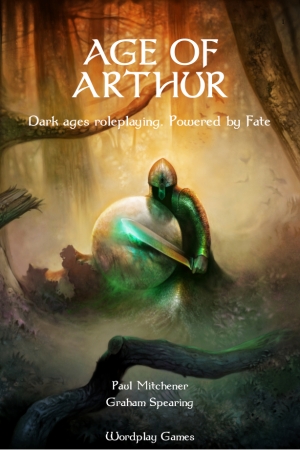
In this blog post I want to talk about my one self-published project, Age of Arthur. I say self-published, but for this one I had a coauthor. We both fell for the Fate system, and after a game of Diaspora we played together in (well, technically, I ran it and Graham Spearing was one of the players, but you know what I mean), we both had an urge to write a Fate-based game.

We had similar likes and dislikes for what would work, so we started working together. Then Graham had the idea for an Arthurian setting with a more dark ages feel than Pendragon (we both loved Bernard Cornwell’s Warlord Chronicles trilogy), and I did lots of research, our friend Andy Sangar put together an Arthurian timeline, and we both did lots of writing. I don’t want to write about the writing and research process, interesting though it was at the time. I want to write about the extra stuff that was involved aside from just writing the thing involved in bringing the game to print.

At various stages in the draft, we each ran a few one-shots using the system, including one that became the scenario in the main book. I also ran a campaign, which let me see for the first time how other people reacted to character generation. I didn’t change the rules during play- that sort of thing tends to derail games, but I did get lots of ideas for tweaks afterwards.

When the tweaks were made, we did some serious self-editing, before contacting an artist, Jason Behnke and map maker, Steff Worthington. Steff came up with a lovely map of dark ages Britain, and, with his friend Genevieve Fournier, gave us some handy feedback on the Gazetteer, which was duly incorporated. And Jason’s art when it came was absolutely beautiful, going a long way to defining the look of the book. It was the quality of the art that led to the decision to make a full colour version available. The art consists of a covers and a full page spread in between each chapter.

We then asked for playtesters (thanks to our lead playtesters, Neil Gow of Omnihedron Games, and Ben Quant), Graham set up a website, and I started promoting by chatting about the game on forums. I started a thread on the ads/promos section of rpg.net, which I seeded with occasional updates, and UK Role Players was good enough to host a forum for the game. Graham set up a page on Google+. This all generated some initial interest which was good.

The playtest feedback was appropriate robust, with comments pointing out that some rules were just plain not working or broken. Others were unclearly written. So we made more changes- that’s what playtesting is for. In particular, Neil really helped us tighten things up.

Then we were nearly done, right? Ha ha ha ha ha. More self-editing. Then an external editor. Mitch Williams volounteered for this noble task, and he helped us clarify many more points in the text where the rules were unclear, and what I thought was a surprising number of little typos and grammatical mistakes. This surprised me- we’d self-edited, and I thought I wrote good anyway. It was embarrassing to find that there were places where I’d done things such as writing “viscous” instead of “vicious”. He’s someone else who went well beyond the call of duty in helping us out.

Oh, and layout. We’d had various ideas, but over time I came to realise I wanted to do layout myself. I knew what I wanted in terms of hyperlinks, bookmarks and index, and I knew that I didn’t trust anyone else to do the job. Lots of work in life is made with that philosophy. Incidentally, by the time I’d started the layout, the initial date I’d mentioned for release of the game had already passed. Whee! There’s a moral there.

So, more layout, which was a fiddly technical job, and more comments from the editor, with bonus layout glitches to spot. More posts on forums as we started getting the lovely finalised art pieces. I also set up a Facebook page to show a bit more off. More interest from people, with a hint of impatience. More helpful advice from Tim Gray of Silver Branch Games, and Neil Gow. Eventually, six months after the initial planned release, the PDF was ready to go. I uploaded it to Drivethrurpg to test it out, and a few hours later realised it was actually on the front page, had generated some interest and sales, and was out there in the world.

We’d done one other thing I thought was rather clever at the time, promising a discount equal to the value of the PDF to any early adopters for the print version when it came out. More on that later. Ah, print. That took another couple of months to sort out. Why? Well, the first few attempts at uploading a print file were turned down- my margins were wrong. Then we got the first proof back, and there were two problems.

The first problem was an example of my ridiculous stupidity- the covers were the wrong way round. The front cover was on the back, and the back on the front. Remember when I said I wouldn’t trust anyone else with the layout? That seemed laughable. The other, worse, problem was that we’d used the printer’s standard colour for the physical book. For what we wanted, standard colour wasn’t good enough. Pages didn’t bleed to the edges, leaving white margins, and worse, the beautiful artwork, which is rather rich and varied in colour, had all life leeched out of it. The book did not look good.

This led to the decision to bring the book out in premium colour, but premium colour is rather expensive, so we did a cheaper black and white version. After a couple of comments, we also decided to go for both hardback and softback options. I hadn’t initially planned hardback, but I’m really glad we went for it in the end.

In the first black and white proof, the tone was out on one of the pictures, but the second proof was fine. Wahey, a book for release! As for the premium colour, the first proof looked breathtaking gorgeous, with a lovely hardback cover, and high quality paper, but the margins were out, leaving white space. Fortunately, the second proof was as we wanted it- and the thicker pages made it look soooo much better than the standard colour version. I was able to wrap up the second proof and take it to Graham Spearing’s birthday party- it had arrived the day before.

So the physical books were released, and discount codes were sent to those who’d bought the PDF. Our travails were, unfortunately, still not over- not every PDF buyer had received the codes. Plenty had settings on Drivethrurpg blocking e-mails from publishers. Incidentally, logging into Drivethrurpg through Facebook sets up such a block automatically. Fortunately, that was solvable by a quick e-mail with the codes for those who got in touch.

I hope I’ll make fewer mistakes next time I self-publish something. I haven’t even catalogued every single error made. I’m glad I did the self-publishing thing. It was hard work. I wouldn’t have managed if it hadn’t been a joint endeavour with Graham, and we hadn’t had advice and help from those mentioned here.

One day I’ll self-publish another project. But not yet!

My Writing Business (Part 2)

In my last post on writing, I spoke about writing for Arc Dream, and making the leap from writing lots down for myself to getting things published. One reason I didn’t say was why I like to get things published. The answer is a not completely comfortable combination of generosity and vanity. Generosity because it’s great to be able to share what I’ve done, and others getting value out of it. Vanity, because it’s nice for me to see others appreciate my work, and to see value in it.

Someone actually giving me money for my work is the most direct way I can think of to see that there’s value in it. Maybe this is all a bit too self-analytical, and writing for publication (or self-publication) is simply another hobby that nicely exists alongside my actual gaming.

After Blood of the Gods for Arc Dream, my next bit of writing was for Newt Newport and D101 Games. Newt seems to be receptive to my ideas (ah, that vanity/appreciation thing again).  He peer-reviewed an early copy of Blood of the Gods, and the first draft was much improved by his input. I’ve done bits and pieces of editing and proof reading on a good few D101 products. Perhaps most significantly, I co-edited the marvellous game of fallen Chinese immortals doing good deeds and kung fu, Monkey.

I’m still rather pleased with Drowned Lands, the first thing I wrote for D101. What is it? Well, here’s the setting pitch (from which you can, if you want, take a good guess at when it was written):

The summer of 2011 was blisteringly hot and humid,
both in Britain and in the rest of the world.
Perhaps nothing too unusual.
Then it started to rain.
Still nothing unusual.
It started to rain everywhere in the world, even in deserts.
And it didn’t stop.
Ever.

It’s a setting included in Worlds of Wordplay– a version of Graham Spearing’s Wordplay RPG including various settings that is published by D101. Drowned Lands is based in VSCA’s Deluge setting toolkit, which, like Wordplay, is creative commons. My setting a rather British post-apocalypse, based around the south coast of England, where I grew up, after a hundred years of constant rain.

While talking about D101 games, I should mention OpenQuest. From the start (before I was writing for D101), I loved OpenQuest, which is a take on fantasy gaming using an engine in the same family as Basic Roleplaying and Runequest, but to my mind more elegant than Basic Roleplaying and simpler than Runequest. I should say here that I also have a soft spot for Runequest’s crunchier take, especially when it comes to combat, but OpenQuest scratches a different itch. I should also mention that OpenQuest 2 is out soon, and the PDF I’ve seen looks great!

I’ve helped a bit with OpenQuest 2, but my big thing for it is a setting I cowrote with Simon Bray called Here Be Dragons. Now this one came into being almost by accident. Both Simon and I submitted articles to Newt on similar themes- mine being a city ruled by a Dragon, and Simon’s on creatures called Dracorians and a scenario based around them. Newt suggested combining them into a book, so we wrote more and did so.

The writing for this one was absolutely frantic, with ideas and e-mails flying back and forth. We were done with a first draft remarkably quickly. I think the result is glorious- a swords and sorcery setting with Simon’s art and maps, a lot of dark stuff, bits inspired by Greek mythology, a city that was my take on Byzantium, and parts of the style owing as much to Pratchett as to anything else. I like writing with a coauthor. It makes me efficient and the results, based on the two times I’ve done it, surprise me in a nice way.

Night’s Black Agents

At the moment I’m rather enjoying running Night’s Black Agents. The premise of the game is simple- “burned” ex-spies working against a vampire conspiracy across Europe and the Near East. The rules are based on Pelgrane Press‘s Gumshoe system for investigative games. This system is pretty straightforward. Player characters have a bunch of investigative skills and general skills. A major clue (ie: something the GM really wants the party to find) is found automatically by any character who has a relevant investigative skill. Extra information can be found through spending points in investigative skills- and more points gives more information.

General skills work simply too- roll d6, and if the result is high enough, the skill succeeds. Points can be spent from the “pool” of an investigative skill before the roll, but the skill level itself has little direct effect. Night’s Black Agents adds a number of things to this chassis. Uses of the Preparedness skill to have items available and fun things like finding hidden caches of spy type stuff, vehicles or weapons. Network and Cover skills for contacts and alternative identities. More detailed rules for combat and chases, including the use of investigative skills to give bonuses. And some extra optional things I didn’t use, such as rules for Trust and Tag Team Tactical Benefits. I thought they’d add too much complexity and not give so much benefit for our particular group.

Actually, I wasn’t initially all that certain about Gumshoe, though I loved the material on conspiracies and vampires. But after an online game of Esoterrorists, and a more detailed read of the rules (including the thing I always do when running a new system, which is writing out my own summary of the rules to use in play and hand out to the players) I wasn’t just reassured- I was positively enthusiastic.

Well, that’s enough of that- this is intended to be a quick post about our game and how the story’s gone so far rather than a review of Night’s Black Agents or Gumshoe. One thing that bothered me a bit was setting the game in the modern day, simply because I’d want to involve countries I’m familiar with to use those experiences (I’m British, and I’ve lived in Germany, France and Denmark), but there’d be something a bit “off” about involving modern politics- and to my mind a conspiracy’s very political. It would be a bit limiting without involving police corruption or even government ministers for example.

So I set the game in 1968. Not just to avoid that, but because it’s a blooming interesting year. You’ve got the Cold War, the Berlin Wall, the Prague Spring, the Paris riots, Andreas Baader blowing up a Frankfurt department store, Swinging London, the arrest of the Krays, police corruption in London and Paris, KGB spies in MI5, the Stasi. That’s just off the top of my head (admittedly off the top of my head after running the game for a few weeks and doing initial research, but still). It’s a complex time, and a great one for spies.

Oh, and here’s my initial diagram of the Vampire Conspiracy, from which I built other things.

Another fun thing in Night’s Black Agents is designing the vampires. I avoided the book’s clever suggestions of alien monsters and mutants, and went for mostly traditional sorts. They have a fairly traditional range of vampiric powers, which mostly can’t be used during the day, though the vampires are otherwise unharmed by sunlight. They can’t be killed except by decapitation, a rowan stake through the heart, or a particular grade of meteorite iron that has been cold-forged so as not to disturb it’s crystalline structure.

A mortal who becomes a vampire (through the drinking of vampiric blood while being drained of their own) goes through a bestial phase in which their humanity is “burned off” before gaining monstrous reason and recovering most of their old memories. Only mortals who are the direct descendants of the Merovingian king actually become “true” vampires, capable of creating others. There is a downside to being a true vampire- mortal beings bleed in their presence. They need agents (whether other vampires, or Renfields- humans dosed with their blood) to do their business.

And there are two clans of vampires fighting a shadow war- the “Bathory clan” and the “Merovingian clan”. More east versus west. I don’t think I’m going to do a full actual play report of my game so far- we’re five sessions into it now- but some highlights are:

  •  Staging a heist on the Natural History Museum in London to steal their meteorite collection.
  •  Scientific experiments on captured vials of True Vampire blood.
  • A player character actually joining the vampire side when tempted. Well, they’d already fallen under the influence through drinking a couple of the aforementioned vials. Long story.
  • One of the player characters inventing mirror shades.
  • The horror hitting home when records looking for one particular missing persons pattern were searched through, and the players realised how many vampires there must be out there.
  • Covert surveillance being one of the main player character strategies.
  • A truly ridiculous husband and wife act two of the player characters put on when they discovered they’d been bugged.
  • A Preparedness check to “remember” a grenade and throw it while fleeing an assassination squad.
  • The player characters developing a healthy caution of the vampires- but being terrified at the prospect of meeting the Krays.

There you go. Not a review or an actual play report. Just a love letter to a game that combines smoke and mirrors spy stuff, quick doses of action, and good old-fashioned investigative horror.